
Can anyone tell me why this rule is broken- on of the + plural noun+ who/that/which + plural verb and no ii) one the only + plural noun + singular verb if no who or which or that is there.
1
Please log in to comment and participate in discussions.
Comments (2)
AFTERBOARDS/Queries
Discussion related to the coachings, options in the market, if you should grab AfterBoards... our team answers all your doubts about the AfterBoards offerings.
973Members
515Posts
Members can post and comment here, and get these posts in their Latest feed.
Moderators
Join AfterBoards
Create an account to join our community and participate in discussions.
- • Connect with peers
- • Resolve doubts
- • Learn more about admissions
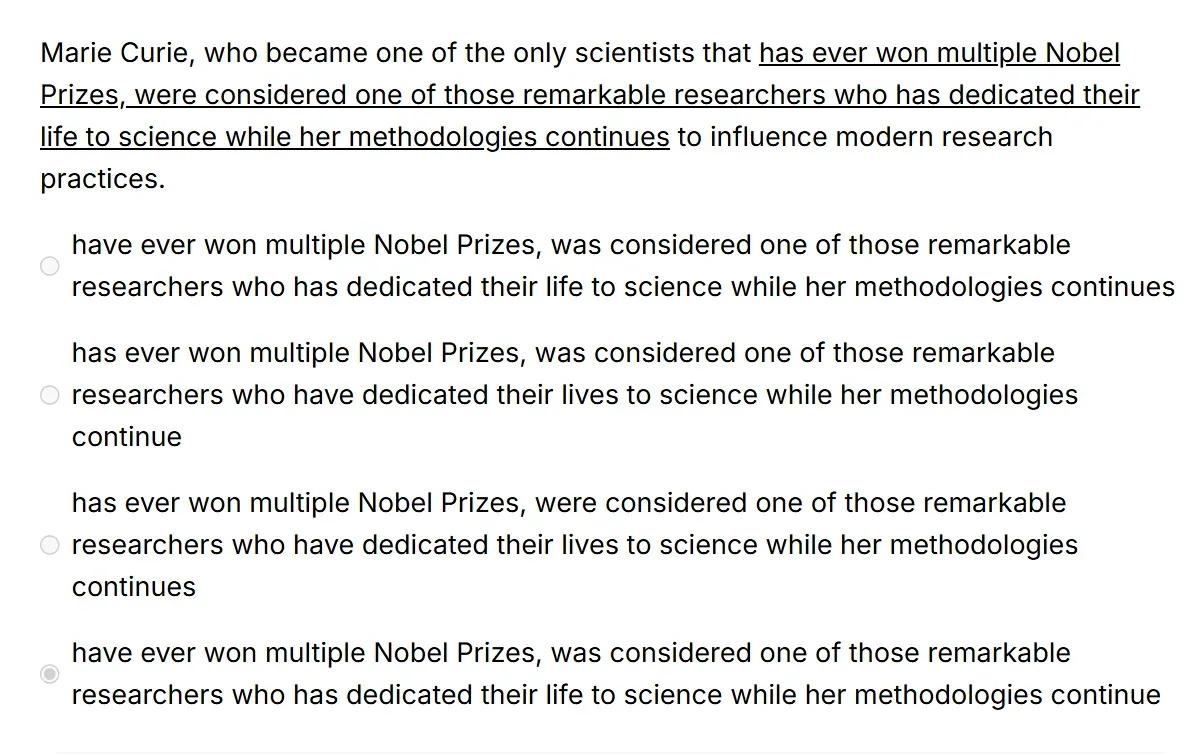
in questions like these its important to look beyond whether "who/that/which" is used or not and blindly follow the rule accordingly. It's important to understand whether the sentence is referring to the individual or the group, to correctly choose the singular or plural form.
To firstly give you a quick way to answer questions like this in the exam with a time pressure, identify all the incorrect pairings of a singular form of a word with a plural form. ie., in this sentence, "HAS ever won" (singular) is followed by "WERE considered" (plural) which is incorrect. So immediately look for options that pair the singular form (has) with plural form (were) or vice versa like plural form (have) with singular form "was", any option containing this pairing is incorrect and therefore can be eliminated. We see that by using this trick we can eliminate options 1,3,4 therefore making option 2 the correct ans. This way you save alot of time in the exam.
The rule is not being broken per say, the rule can be applied once you know whether the sentence is talking about the individual or the group.
Now for the actual method of solving and understanding which forms of the words to use where.
First, read the entire sentence properly, and also read all the options to identify which part of the sentence is talking about the individual and which is talking about the group.
Looking at the options, we see that the phrase “dedicated THEIR” remains unchanged, from this we understand that, this part of the sentence “remarkable researchers who has dedicated their” is talking about the GROUP, so the “has” in that part must be changed to “have” (plural, since it's about the group).
The sentence reads “ HAS ever won multiple Nobel prizes, WERE considered one of those remarkable researchers who HAS dedicated THEIR life to science while her methodologies CONTINUES…” the words “has” and “were” cannot go together, since one is singular (has) and the other is plural (were). The third identification would be “methodologies continues” methodologies is plural and therefore must be followed by “continue” instead of “continues”.
After identifying these errors, eliminate any option that has these pairs. Next, in all options beginning with “have ever won..” the sentence is paired with “was considered”, but like mentioned, they are pairing plural(have) with singular (was), which again is incorrect. Now we’re down to two options beginning with has, and only one that pairs “has” with “was” and accounts for both “have dedicated” (plural) followed by "their lives” (plural) and also methodologies continue (plural), making it the clear correct answer. Always read the question entirely and the options too, before jumping to conclusions.
Option elimination by identifying incorrect pairs of singular and plural form of words gives you a quick way to solve such questions.